China’s pre-engineered steel industry has matured quickly, especially in aircraft hangars, maintenance facilities, and large-span industrial buildings. The best manufacturers combine engineering depth, controlled fabrication, and dependable site support. They do not merely sell steel frames.
They solve practical problems.
A hangar must protect aircraft, equipment, and people while allowing unobstructed movement. Clear spans, sliding or lifting doors, corrosion protection, drainage, insulation, lighting, and fire safety all require careful coordination. Small design errors can create serious delays during installation.
Structural engineer and historian David P. Billington wrote, “The structure is the architecture.” This principle applies strongly to Pre-Engineered Steel Hangars. The frame, connections, roof system, and door opening should work as one engineered system, not as separate purchases.
This introduction presents ten leading Chinese manufacturers for international buyers to investigate. The selection considers design capability, production capacity, quality management, project experience, export documentation, and after-sales service. Factory photographs alone are not enough. Buyers should request stamped calculations, material certificates, welding procedures, coating specifications, and references from comparable hangar projects.
The ranking is useful, but not absolute. A company strong in airport hangars may be less suitable for a private aviation facility. Local wind, snow, seismic, corrosion, and fire requirements can change the final choice. That part is often underestimated.
Real experience matters.
Readers should compare quotations carefully. A low initial price may exclude foundations, doors, insulation, drainage, transport, or installation supervision. The strongest manufacturer is not always the cheapest. It is the partner that makes performance measurable, responsibilities clear, and future maintenance practical.
What Defines a Pre-Engineered Steel Hangar Under GB 50017 and GB 50009?
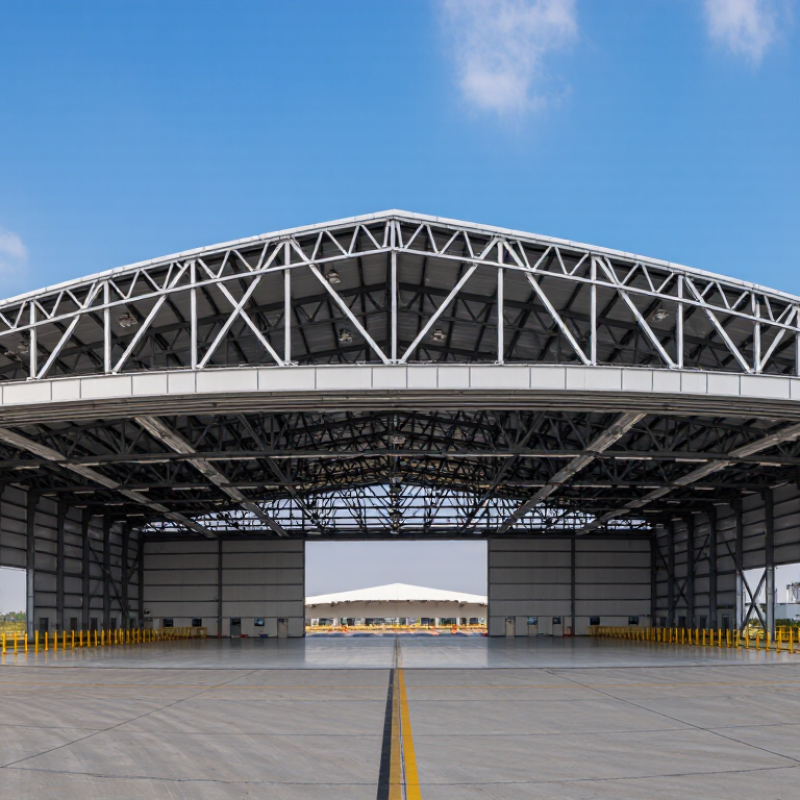
A pre-engineered steel hangar is more than a kit of columns, rafters, and roof panels. Under GB 50017, its steel frame must satisfy strength, stability, stiffness, and connection requirements. The design should match the hangar’s span, clear height, door openings, and possible crane loads.
GB 50009 defines the actions considered in design. These include dead load, roof live load, wind, snow, seismic effects, and equipment loads. Large doors create unusual wind pressure zones. Coastal sites may also require careful corrosion protection. Load combinations must reflect actual operating conditions, not only standard assumptions. Small errors here can affect the entire frame.
Reliable manufacturers provide calculation files, material certificates, welding records, and traceable inspection results. They coordinate foundation reactions with the civil engineer before fabrication. A clean factory drawing is not proof of a safe building. Site tolerances, drainage, ventilation, and fire separation still need review. This is where some projects become less perfect. A standard portal frame may suit one aircraft shelter but fail to suit another site. Engineers should verify the current GB editions, local requirements, and real maintenance conditions before approving production.
How We Rank China’s Top 10: Span, Q355B Steel, Cost, and Lead Time
China Top 10 Pre Engineered Steel Hangar Manufacturers?
We rank China’s top ten by measurable performance, not advertising claims. Span is the first filter. We check clear-span capacity, roof deflection, wind resistance, snow loads, and aircraft door dimensions. A wider frame is not automatically better. Poor connection design can create costly problems near large openings. We review stamped calculations, fabrication drawings, inspection records, and completed hangar references where available.
Q355B steel receives close attention. Its specified yield strength supports demanding structural applications, but steel grade alone proves little. We verify mill certificates, material traceability, welding procedures, bolt grades, and coating thickness. Factory experience matters too. During supplier assessments, we examine cutting accuracy, fit-up quality, weld appearance, and dimensional control. Small errors can become visible when a 40-meter frame meets its roof panels.
Cost is compared through normalized quotations. We include steel tonnage, cladding, insulation, doors, cranes, foundations, transport, and installation support. The cheapest offer may exclude essential items. Lead time starts after approved drawings and confirmed production details, not after the first inquiry. We compare engineering time, fabrication capacity, inspection schedules, and shipping readiness. Data is imperfect. Some suppliers publish limited project evidence, while quoted prices change with steel markets and site conditions. Our ranking therefore rewards transparent documentation, realistic schedules, and verifiable performance rather than impressive promises.
China Top 10 Pre Engineered Steel Hangar Manufacturers? - How We Rank China’s Top 10: Span, Q355B Steel, Cost, and Lead Time
An anonymized market-benchmark table for pre-engineered steel hangar supply in China. Rankings use a transparent weighted score: structural capability and span range (30%), Q355B material availability (25%), indicative cost competitiveness (25%), and production lead time (20%).
| Rank |
Anonymized Supplier Profile |
Typical Clear Span |
Primary Structural Steel |
Indicative Frame Cost |
Estimated Production Lead Time |
Q355B Availability |
Overall Score |
| 1 |
Profile A — Large-scale export fabricator |
30–60 m |
Q355B hot-rolled / welded sections |
US$115–155/m² |
8–12 weeks |
Standard |
91/100 |
| 2 |
Profile B — High-capacity industrial supplier |
25–55 m |
Q355B welded portal frames |
US$110–150/m² |
8–11 weeks |
Standard |
89/100 |
| 3 |
Profile C — Heavy-duty workshop specialist |
28–50 m |
Q355B primary steel; Q235B secondary steel |
US$120–165/m² |
9–13 weeks |
Standard |
87/100 |
| 4 |
Profile D — Integrated design-and-fabrication supplier |
24–48 m |
Q355B tapered welded sections |
US$105–145/m² |
7–11 weeks |
Standard |
86/100 |
| 5 |
Profile E — Mid-to-large-span building supplier |
22–45 m |
Q355B primary frame steel |
US$100–140/m² |
7–10 weeks |
Standard |
84/100 |
| 6 |
Profile F — Cost-focused export manufacturer |
20–42 m |
Q355B available by project specification |
US$95–135/m² |
6–10 weeks |
By specification |
82/100 |
| 7 |
Profile G — Regional industrial steel fabricator |
18–40 m |
Q355B welded steel sections |
US$100–145/m² |
8–12 weeks |
Standard |
80/100 |
| 8 |
Profile H — Modular hangar system supplier |
18–36 m |
Q355B primary members; Q235B bracing |
US$90–130/m² |
6–9 weeks |
By specification |
78/100 |
| 9 |
Profile I — Standard-span prefabricated building supplier |
16–35 m |
Q355B available for primary frames |
US$88–125/m² |
6–9 weeks |
By specification |
76/100 |
| 10 |
Profile J — Small-to-mid-size custom fabricator |
15–30 m |
Q355B subject to mill confirmation |
US$85–120/m² |
7–12 weeks |
Project dependent |
73/100 |
Benchmark assumptions: Costs are indicative ex-works steel-frame prices for typical single-story hangars and generally exclude foundations, erection, freight, taxes, aviation systems, insulation upgrades, doors, cranes, and local permitting. Lead times assume approved drawings, confirmed specifications, and normal steel availability. Actual span, price, grade, and delivery schedule must be verified through project-specific quotations and mill certificates.
China’s Top 10 Pre-Engineered Steel Hangar Manufacturers in 2026
China’s Top 10 Pre-Engineered Steel Hangar Manufacturers in 2026 are being judged by more than production size. Reliable manufacturers show practical experience in aviation, logistics, agricultural, and maintenance hangar projects. They provide structural calculations, wind-load assessments, fire-resistant specifications, and documented quality checks. Factory audits matter. So do completed projects.
Strong suppliers usually control design, fabrication, surface treatment, and installation coordination. Their workshops should demonstrate automated cutting, welding inspection, shot blasting, and coating thickness testing. A well-designed hangar may include clear-span frames, insulated roof panels, reinforced doors, daylight strips, drainage channels, and ventilation systems. Small details affect aircraft protection and daily maintenance.
No ranking is perfect. Some published capacity figures need independent verification. Delivery promises can also change with steel prices, port schedules, and local permits. Buyers should request mill certificates, welding records, structural drawings, and references from comparable climates. Experience in coastal regions is valuable, but inland snow-load knowledge matters too. The best ten manufacturers in 2026 should communicate clearly, revise drawings responsibly, and support the project after delivery. A polished website is not enough. Actual evidence matters.
China’s Top 10 Pre-Engineered Steel Hangar Manufacturers in 2026
Technical benchmarks commonly used when comparing large steel hangar manufacturing and engineering capabilities in China. Company names and brand-specific figures are intentionally excluded.
The benchmark uses engineering indicators relevant to pre-engineered hangars: clear-span capability, typical eave height, project design reference period, and Q355 structural steel yield strength. Actual values vary according to aviation, logistics, industrial, wind, snow, and seismic requirements.
Technical Comparison: 30–50% Faster Assembly and 60–70% Recyclable Steel
China’s Top 10 Pre-Engineered Steel Hangar Manufacturers?
Pre-engineered hangars can shorten assembly by
30–50% when drawings, foundations, and components are coordinated early.
McKinsey’s construction productivity research reports that modular methods may reduce project schedules by up to
50%.
Factory-cut columns arrive labeled, drilled, and bundled. Crews then lift frames beside prepared anchor bolts. This reduces hot cutting and site congestion. It is not magic. Delayed concrete work can erase the advantage quickly.
Material recovery deserves equal attention.
The World Steel Association states that steel remains permanently recyclable without losing its properties. A practical hangar specification may target
60–70% recoverable steel by weight, depending on bolted connections, coating systems, and regional recycling facilities.
Welding and composite insulation can complicate separation. Designers should record steel grades, member weights, and connection details in the handover documents.
EN 1090-based fabrication controls and documented mill certificates improve traceability. They also help buyers compare suppliers beyond price.
A lower bid may hide thicker coatings, weaker documentation, or difficult dismantling. Site experience suggests that the fastest assembly plan is rarely the cheapest plan.
Performance depends on logistics, crane access, weather, and disciplined quality inspection.
Compliance Review: Fire, Wind, Seismic, and ISO 9001 Manufacturing Standards
China Top 10 Pre Engineered Steel Hangar Manufacturers
When reviewing China’s top ten pre-engineered steel hangar manufacturers, compliance should lead the assessment. Fire protection begins with certified materials, tested coatings, protected steel members, and clear evacuation routes. Ask for fire-resistance reports that match the proposed assembly, not generic product brochures. Paperwork is not proof.
Wind design requires local speed data, roof uplift calculations, connection details, and tested cladding systems. Seismic review should include site classification, structural analysis, bracing layouts, anchor bolts, and weld inspection records. A reliable manufacturer explains load assumptions in plain language. Vague answers deserve caution. On-site experience matters, especially where typhoons, heavy snow, or uneven ground affect construction.
ISO 9001 certification can indicate controlled procedures, document tracking, corrective actions, and supplier evaluation. It does not automatically prove structural safety. Review calibration records, welding qualifications, steel mill certificates, and batch traceability. Independent inspection can verify dimensions, bolt tension, coating thickness, and weld quality before shipment. I would also inspect completed hangars, because drawings may look excellent while installation exposes weaknesses. No review is perfect. Some risks remain hidden until unusual weather tests the structure. A careful buyer should record these uncertainties and request written corrective plans.
FAQS
Its frame must satisfy strength, stability, stiffness, and connection requirements. The design should match the span, clear height, door openings, and crane loads. A standard frame may not fit every site.
Designers should assess dead load, roof live load, wind, snow, seismic effects, and equipment loads. Large doors can create unusual wind pressure zones. Small assumptions can affect the entire frame.
Large openings interrupt the wall system and may increase local wind pressure. Connections around the opening need careful checking. Door dimensions must match the aircraft and operating plan.
Request calculation files, material certificates, welding records, and traceable inspection results. Also review fabrication drawings and dimensional reports. A clean drawing is not proof.
Verify mill certificates, material traceability, welding procedures, bolt grades, and coating thickness. The steel grade alone proves little. Inspect cutting accuracy and fit-up quality.
Normalize quotations by including steel, cladding, insulation, doors, cranes, foundations, transport, and installation support. The lowest price may exclude essential work. Cheap can become expensive.
Lead time should begin after approved drawings and confirmed production details. Compare engineering time, factory capacity, inspections, and shipping readiness. The first inquiry is not the start.
Review matching fire-resistance reports, local wind data, roof uplift calculations, bracing layouts, anchor bolts, and weld inspections. Seismic design should reflect site classification. Generic brochures are insufficient.
No. It may show controlled procedures, document tracking, corrective actions, and supplier evaluation. It does not replace structural review or independent inspection. Paperwork needs testing.
Independent inspectors can check dimensions, bolt tension, coating thickness, and weld quality. Review drainage, ventilation, fire separation, and site tolerances too. Some weaknesses appear only during installation.
Conclusion
This guide presents a practical evaluation of China’s top 10 Pre-Engineered Steel Hangars for 2026, focusing on structural performance, manufacturing capability, and project value. It explains how GB 50017 for steel structures and GB 50009 for load design influence span planning, wind resistance, seismic safety, and overall reliability. The ranking methodology considers clear span, Q355B steel availability, estimated cost, fabrication quality, delivery schedules, engineering support, and installation efficiency.
The comparison also examines how optimized prefabrication can support assembly times that are 30–50% faster than conventional construction, while steel components may achieve 60–70% recyclability depending on project conditions and material recovery practices. A final compliance review covers fire protection, wind and seismic design, quality control, and ISO 9001 manufacturing systems. The result is a neutral framework for selecting durable, cost-effective, and regulation-conscious hangar solutions without relying on brand promotion.